
Devdatt Nerurkar
Founder of WiserWill
Will Versus Succession Certificate in India
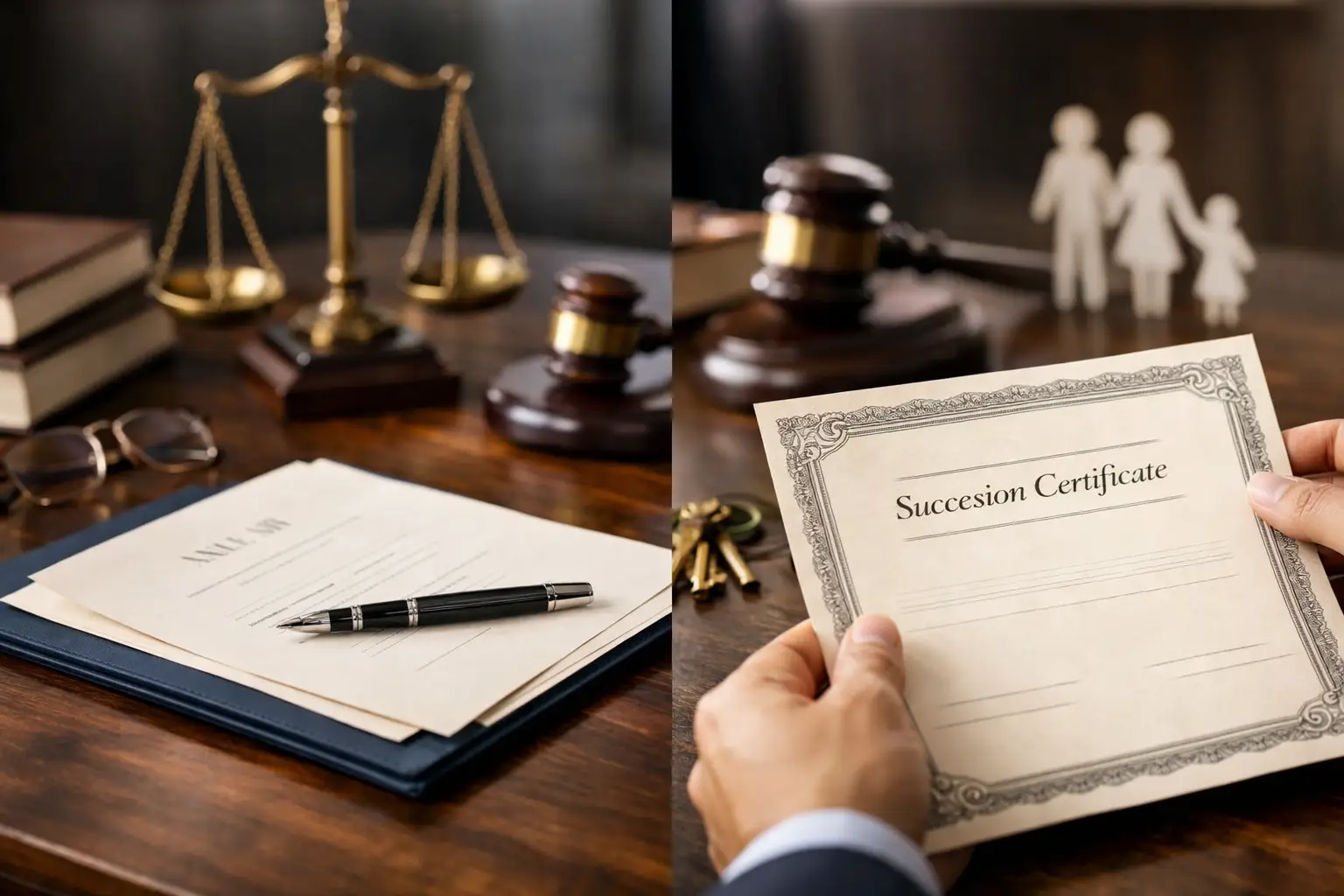
A family may find a signed Will in a drawer and still be asked by a bank, broker, or court for more paperwork. That is why the question of will versus succession certificate matters. These documents serve different legal purposes in India, and having one does not always mean the other will never be required.
A Will lets you state who should receive your assets after your death. A succession certificate is a court-issued document used primarily to collect debts and securities belonging to someone who has died. Understanding the distinction can help you plan with more clarity and help your family avoid unexpected delays when they need access to funds.
Will Versus Succession Certificate: The Core Difference
A Will is a private legal declaration made by you during your lifetime. It records your wishes for the distribution of assets, appoints an executor to carry them out, and can name guardians for minor children. You can change or replace it while you are mentally capable of doing so.
A succession certificate is obtained after death from a court. It identifies the person or people entitled to collect specified debts and securities, such as bank balances, fixed deposits, shares, mutual funds, insurance proceeds, or amounts payable by an employer. It does not generally decide every question of ownership or settle the distribution of all estate assets.
Put simply, a Will expresses your plan. A succession certificate gives legal authority to recover certain movable financial assets when an institution requires court-backed proof.
When a Will Is Usually the Right Starting Point
For most adults with assets, dependents, or clear wishes about inheritance, a Will is the essential planning document. It allows you to decide who receives your home, savings, investments, jewelry, business interests, digital assets, and personal belongings. Without a Will, your estate is distributed under the applicable succession law rather than according to your personal preferences.
A properly prepared Will can also reduce conflict. It gives your family a written record of your decisions, identifies the executor responsible for administration, and can explain special instructions such as care for a dependent relative or how a particular asset should be handled.
Parents of minor children should pay particular attention to guardianship. A succession certificate cannot appoint a guardian for your children. A Will can state whom you wish to care for them if both parents are unavailable, although the court retains the power to decide what is in the child’s best interests.
A Will is not limited to people with large estates. If you have a bank account, investments, insurance, a vehicle, property, or belongings of personal value, your family benefits from knowing your intentions.
When a Succession Certificate May Be Needed
Financial institutions do not all follow the same process after an account holder dies. If there is a valid nomination, a clear Will, and no dispute among family members, some institutions may release assets after receiving the required documents. Those documents can include the death certificate, identity proofs, claim forms, and indemnities.
But an institution may ask for a succession certificate when there is no nomination, no acceptable Will, uncertainty about the legal heirs, competing claims, or a significant amount at stake. It may also be needed where the deceased left behind debts or securities and the institution wants formal protection before making payment.
The certificate is commonly relevant for movable assets, not for transferring title to immovable property such as land or a house. Property transfers may involve a Will, probate or letters of administration where applicable, revenue records, local registration requirements, and other documentation. The correct route depends on the asset, location, personal law, and whether anyone contests the claim.
Does a Will Eliminate the Need for a Succession Certificate?
Not always. A valid Will can make your wishes clear and may be sufficient for many estate-related steps. However, a bank, company, or other institution can still request probate, a succession certificate, or another court order based on its rules and the circumstances of the case.
This is especially likely when there is a dispute, the document’s authenticity is questioned, an asset is held without a nominee, or an institution needs a specific form of legal protection before releasing funds. A succession certificate can also be sought even when the deceased did not leave a Will.
The key point is that a succession certificate is not a substitute for thoughtful estate planning. It is a post-death court process. A Will is your opportunity to make decisions in advance.
Probate, Letters of Administration, and Succession Certificates
These terms are often used interchangeably, but they are not the same.
Probate is a court process that confirms the validity of a Will and authorizes the executor to administer the estate. Probate requirements can vary by location and the nature of the property. For example, probate is mandatory for certain Wills made within the former presidency towns of Mumbai, Chennai, and Kolkata when the relevant legal conditions apply.
Letters of administration may be issued when a person dies without a Will, or when there is a Will but no executor is able or willing to act. They authorize an administrator to manage the estate.
A succession certificate is generally narrower. It is focused on debts and securities and is issued under the Indian Succession Act. It enables the holder to collect those assets and provide a valid discharge to the institution paying them. It does not permanently resolve every inheritance dispute or establish final ownership of all estate property.
Because these processes can overlap in difficult estates, families should not assume that one document will answer every requirement.
A Simple Example
Assume Priya owns an apartment, several mutual funds, a savings account, and family jewelry. Her Will gives the apartment to her daughter, divides the mutual funds between her two children, and gives the jewelry to her niece. It also appoints her brother as executor.
After Priya’s death, the executor can use the Will to begin administering the estate. The apartment transfer may require property-specific records and, depending on the circumstances, probate or other legal steps. If a mutual fund company is satisfied with the Will and supporting documents, it may process the claim. If there is no nomination and one child disputes the claim, the institution or court process may require additional authority, potentially including a succession certificate for the securities.
The Will still has great value. It tells the family and the court what Priya intended. But it does not guarantee that every organization will follow the same documentation path.
Nominations Do Not Replace a Will
A nominee is the person named to receive an asset from an institution after the holder’s death. This is useful because it can make the claim process easier. But a nomination does not always determine who ultimately owns the asset under succession law.
For that reason, your nominations and your Will should be reviewed together. If your nominee is different from the person you want to inherit, your family may face confusion or conflict. Keeping both records aligned is usually the clearest approach.
How to Make Your Will More Useful for Your Family
A vague or incomplete Will can create the very uncertainty it was meant to prevent. Start by listing your assets and identifying how each should pass. Include bank accounts, investments, real estate, insurance, vehicles, business interests, valuables, and digital accounts where relevant.
Choose an executor who is dependable, likely to outlive you, and capable of handling paperwork. You may name a substitute executor in case your first choice cannot act. Keep the original signed Will in a place your executor can locate, and tell them where it is stored without necessarily sharing every private detail.
For a Will in India to be valid in ordinary circumstances, it should be signed by the testator and attested by two witnesses. Witnesses should be adults who are not beneficiaries or the spouses of beneficiaries, as this can affect the gift made to them. Registration is generally optional, but it may be considered in some situations after obtaining appropriate legal guidance.
Your Will should be reviewed after major changes such as marriage, divorce, the birth of a child, a property purchase, a business change, or the death of a beneficiary or executor. A current Will is more useful than one drafted years ago and forgotten.
Plan Before Your Family Has to Apply to Court
A succession certificate can be necessary and helpful when financial assets must be collected after death. Yet it is not a document you create to set out your wishes. It is a remedy your family may need to pursue later, with court fees, notices, and time involved.
Creating a clear Will while you can make decisions calmly gives your family a better starting point. Wiser Will helps Indian adults create a lawyer-verified Will through a guided, privacy-conscious process at one flat price. Where your estate involves disputes, complex personal-law questions, or cross-border assets, seek individualized legal advice alongside your planning.
The most considerate step is not to leave your family guessing which documents they need. Put your wishes in writing, keep your records organized, and give the people you trust a clear path forward.
